

 Posts
Posts


We were out on a trip to the pet cemetery to visit the cats' graves and while we were getting the flowers out of the the car I heard what sounded like geese. That was odd since I didn't recall there being any water around the pet cemetery.
Sometimes geese fly overhead, and we looked around but nothing. The noise got louder and louder, and it sounded like hundreds of geese. Where were they?
Finally, maybe a thousand feet up in the air, we saw these tiny dots like dust specks swirling about and sometimes forming huge v's. These were the geese!
It was not just mesmerizing, but supernatural. Wave after wave of groups of screaming geese swept over us at that thousand feet (or more?) heights. Tens of thousands of geese, each group calling to one another and the sounds drifting down to us. It went on for most of twenty minutes until we finally left the cemetery - but it may have been going on for hours.
One other weird thing, too. Below the geese, perhaps only a few hundred of so feet up, there were at least a dozen turkey vultures circling. It seemed obvious, they were awaiting a tired goose to fall out of the sky so they could pounce on the crushed feathered body. We saw at least one hawk, too.
All in all, this was a weird and powerful experience.
Saturday, November 28, 2009


Monday, September 14, 2009
Monarch Migration at Bernheim Forest (KY)
Mr. Bruggers, I apologize.
I meant no disrespect, and here is the link. I have removed the rest of the text and images.
http://www.courier-journal.com/article/20090913/GREEN/909130344/1008/NEWS01
Please visit Mr. Bruggers article.
Volunteers track monarch migration as population shrinks
By James Bruggers • jbruggers@courier-journal.com • September 13, 2009
Monarch butterflies glide and soar like hawks ... more ...
I meant no disrespect, and here is the link. I have removed the rest of the text and images.
http://www.courier-journal.com/article/20090913/GREEN/909130344/1008/NEWS01
Please visit Mr. Bruggers article.
Volunteers track monarch migration as population shrinks
By James Bruggers • jbruggers@courier-journal.com • September 13, 2009
Monarch butterflies glide and soar like hawks ... more ...
Is the Loch ness Monster a Real Eel?


Steve Alten, a native of Philadelphia, holds a Bachelors degree in Physical Education from Penn State University, a Master in Sports Medicine from the University of Delaware, and a Doctorate degree in Sports Administration from Temple University. His first book, MEG; A Novel of Deep Terror was a N.Y.Times bestseller and was sold in more than a dozen countries.
I had no idea about any of his Loch Ness (real life) theories until I heard him on George Noory the other night. He's spent much time and money trying to figure out the Loch Ness mystery.
His opinion is based on a theory that Sargasso Sea species of eel has for millenia been carried by sea currents into inland water systems of Great Britain. It's true and many specimens have been found. Steve himself apprently posted a bounty for evidence, and a tooth of an eel was found in a half-eaten deer carcass on an island of a small lakelet. That tooth was huge, and allegedly this model is based on that tooth or one like it.
Eels do not die unless they spawn. However, lake-locked eels cannot spawn unless they can escape and swim back to Sargasso spawing grounds. Otherwise they live much over 100 years, and continue to grow as they eat.
They love dark, deep, cold water - and thus Loch Ness is an ideal area - plenty of food, lenty of deep, dark, cool water.
And they have teeth. And they are amphibious and can not only crawl on land, small eels can climb trees like a snake. There is no escape once they latch onto "food" which could include peoples. Eek.
These are images that folks associated with Alten have found and formed. Be afraid of the dark waters - be very afraid.
Sunday, September 13, 2009
Weird Pink Grasshopper!

11-year-old boy finds pink grasshopper
A rare pink grasshopper has been found by a schoolboy taking part in a nature trail.
By Richard Savill
Published: 7:00AM BST 11 Sep 2009
Pink grasshopper: The insect was identified by wildlife officers as an adult female common green grasshopper, which has been born pink. Photo: APEX
The insect was found by 11-year-old Daniel Tate who thought it was a flower until he saw it jump and then he realised it was a grasshopper.
The insect was later identified by wildlife officers as an adult female common green grasshopper, which has been born pink.
Daniel, who attended the wildlife event at Seaton Marshes, near Sidmouth, Devon, with his great grandfather, said: "I was looking for grasshoppers when I saw something pink.
"I thought it was a flower but I saw it moving, so I tried to catch it. It jumped and then I knew it was a grasshopper."
He added: “I was really excited to hear that no one else had found a pink grasshopper at that place before.”
Fraser Rush, nature reserves officer for East Devon District Council, said: “There are millions of common green grasshoppers but I have never seen a pink one. The female comes in a variety of colours, normally different shades of green and brown. Occasionally it tends towards purple, but this is a leap beyond that to pink.”
He added: “Pink grasshoppers are unusual but not unheard of. However the intensity of the pink in this case must make it highly unusual.”
Mr Rush said the pink grasshopper was “a natural variety of the species, albeit a rare one. It has not been caused by any mutation, or any environmental effects.”
He added: “There is a chance it will have bred already and will pass on its pink gene.”
After being studied the grasshopper was released back into the reserve.
Sunday, July 12, 2009
Giant Worm of Moscow, Idaho

Searchers shovel Northwest dirt seeking giant worm
By NICHOLAS K. GERANIOS (12 July 2009)
MOSCOW, Idaho (AP) — The giant Palouse earthworm has taken on mythic qualities in this vast agricultural region that stretches from eastern Washington into the Idaho panhandle — its very name evoking the fictional sandworms from "Dune" or those vicious creatures from the movie "Tremors."
The worm is said to secrete a lily-like smell when handled, spit at predators, and live in burrows 15 feet deep. There have been only a handful of sightings.
But scientists hope to change that this summer with researchers scouring the Palouse region in hopes of finding more of the giant earthworms. Conservationists also want the Obama administration to protect the worm as an endangered species, even though little research has been done on it.
The worm may be elusive, but there's no doubt it exists, said Jodi Johnson-Maynard, a University of Idaho professor who is leading the search for the worm. To prove it, she pulled out a glass tube containing the preserved remains of a fat, milky-white worm. One of Johnson-Maynard's graduate students found this specimen in 2005, and it is the only confirmed example of the species.
The worm in the tube is about 6 inches long, well short of the 3 feet that early observers of the worms in the late 1890s described. Documented collections of the species, known locally as GPE, have occurred only in 1978, 1988, 1990 and 2005.
The farmers who work the rich soil of the Palouse — 2 million acres of rolling wheat fields near the Idaho-Washington border south of Spokane — also have had little experience with the worm.
Gary Budd, who manages a grain elevator in Uniontown, said no farmer he knows has talked about seeing the worm. He compared the creature to Elvis.
"He gets spotted once in awhile too," Budd joked.
Johnson-Maynard and her team of worm hunters are working this summer at a university research farm and using three different methods to try and find a living worm.
One involves just digging a hole and sifting the soil through a strainer, looking for any worms that can be studied.
The second involves old-fashioned chemical warfare, pouring a liquid solution of vinegar and mustard onto the ground, irritating worms until they come to the surface.
The third method is new to this search, using electricity to shock worms to the surface.
"The electro shocker is pretty cool," said Joanna Blaszczak, a student at Cornell who is spending her summer working to find the worm alongside Shan Xu, a graduate student from Chengdu, China, and support scientist Karl Umiker.
The shocker can deliver up to 480 volts. That makes it dangerous to touch, and it could potentially fry a specimen.
On a recent day, Umiker drove eight 3-foot-long metal rods into the ground in a small circle and connected them to batteries. Then he flipped the switches. The only sound for several minutes was the hum of a cooling fan.
"I'm kind of bummed we haven't seen anything yet," Umiker said.
Eventually, a small rust-colored worm dug its way to the surface. It was not a GPE, but it was collected for study anyway.
The search for the giant worm is reminiscent of efforts in Louisiana, Florida and the swamps of eastern Arkansas to find the elusive ivory-billed woodpecker. The large, black-and-white bird was believed to be extinct until a reported sighting five years ago stirred national experts and federal funding to launch a full-blown campaign to verify its existence. Search efforts later dwindled after biologists and volunteers were unable to find the evidence they were looking for.
The GPE was described as common in the Palouse in the 1890s, according to an 1897 article in The American Naturalist by Frank Smith. Smith's work was based on four samples sent to him by R.W. Doane of Washington State University in nearby Pullman.
Massive agricultural development soon consumed nearly all of the unique Palouse Prairie — a seemingly endless ocean of steep, silty dunes — and appeared to deal a fatal blow to the worm.
They were considered extinct when Idaho graduate student Yaniria Sanchez-de Leon in 2005 stuck a shovel into the ground to collect a soil sample and found the worm that now is in the tube in Johnson-Maynard's office.
Conservation groups quickly petitioned the U.S. Fish and Wildlife Service to protect the worm as an endangered species, citing as proof the lack of sightings. But the agency said there simply was not enough scientific information to merit a listing.
Conservationists recently filed a second request, saying they had more information. They are also hoping the Obama administration will be more friendly than the Bush administration. The GPE would be the only worm protected as an endangered species.
Doug Zimmer of the Fish and Wildlife Service in Seattle said the agency isn't ready to comment on the petition.
"It's always good to see new information and good science on any species," Zimmer said.
Farmers are keeping a wary eye on the process.
"The concern is whether a listing is going to end up curtailing farming activities," said Dan Wood of the Washington State Farm Bureau. "I don't know if people plan to stop all farming for the possibility of a worm being somewhere."
Most earthworms found in the Northwest originated in Europe, arriving on plants or in soil shipped to the New World. The giant Palouse earthworm is one of the few native species, and has become quite popular with the public.
While it's tough to come by a live GPE, visitors seem happy to take a picture with a dead one. Johnson-Maynard said she has received calls from tourists who want to come to her office and be photographed with the specimen.
"A lot of people are curious about it," she said.
Wednesday, June 10, 2009
two-toned squirrel

Two-Toned Squirrel
From Coast to Coast AM 10 June 2009
June, 6 2009-- I looked out the window and saw a squirrel unlike any I've ever seen. When I was taking the pictures inside, I thought it was two different species, half and half. When I got outside it almost looked like the squirrel lost all its fur on the front side. and after it climbed the tree a bit, it looked more like a young squirrel that hasn't fully grown into its adult fur and color. I'm still not sure what this squirrel's deal is.
--Petro
Monday, January 12, 2009
Cow that escaped slaughterhouse dies
Read how the cows gathered around in the last moments as protection, and with their own brand of care.
_____
Cincinnati leap to freedom won hearts
Cincinnati Freedom, the fugitive cow who drew headlines around the world when she escaped from a slaughterhouse in Ohio in 2002 and eluded authorities for 11 days, has died at an animal sanctuary in New York.
The 2,000-pound white Charolais, "adopted" by internationally renowned artist Peter Max after her stirring escape in Cincinnati, was put down Dec. 29 at the Farm Sanctuary in Watkins Glen, N.Y., shortly after being diagnosed with spinal cancer.
The quickly spreading cancer, which becomes apparent in cows only when the size of the tumor puts pressure on the spine, caused the cow, who often was called Cinci or Freedom for short, to lose the use of her back legs.
The day before Cinci's death, Farm Sanctuary officials noticed her stumbling, and by the following day she was paralyzed and couldn't walk, said Susie Coston, the sanctuary's national shelter director.
Even so, Cinci, always shy around humans, tried to crawl away when a veterinarian arrived to examine her, Coston said.
Cinci's closest pals in the sanctuary's herd of about 50 cattle -- other slaughterhouse escapees that include Queenie from Queens, N.Y., Maxine from New York and Annie Dodge from Vermont -- were no more thrilled to see the vet and dented her car, Coston said.
The evening before, when her immobility kept Cinci in the pasture, her bovine buddies spent the night with her.
"She had some very good friends who were very protective of her," Coston said.
After the vet determined there was no hope Cinci would recover use of her legs, sanctuary officials decided to euthanize her.
Again, the herd surrounded Cinci, with one of the oldest steers, Kevin, licking her face, while Iris, an older female, licked her back in her final minutes, said Natalie Bowman, the sanctuary's communications director. They remained with Cinci until she was buried after initially chasing a worker, who had arrived to handle the task, back to his tractor.
"It was very moving," Coston said. "I've never seen anything like it. You really saw all those basic emotions at work."
Cinci became a folk hero in February 2002 when, moments before she was to be slaughtered, she jumped a 6-foot fence at Ken Meyer Meats in Cincinnati and evaded police and officials from the Society for the Prevention of Cruelty to Animals for a week and a half while foraging in Mount Storm Park.
News outlets from Canada, England, France, Germany and Australia covered the saga, which also repeatedly made the national news. Then-Mayor Charlie Luken pledged to give her a key to the city.
After her capture, Max, saying he was "very touched by this cow's run for freedom, for life," bought the animal from Meyer Meats and paid to send her to the sanctuary in upstate New York, where hundreds of animals rescued from slaughterhouses, stockyards and factory farms receive lifelong care.
Max named the cow Cincinnati Freedom. He also often called her Cindy Woo, Coston said.
Sanctuary officials were not certain of Cinci's age but estimate that she was 6 to 8 years old when she arrived in April 2002.
"That's a pretty good life for a Charolais," Coston said.
At the sanctuary, Cinci apparently found that it was more fun to eat when one did have not to worry any longer about being eaten herself, gaining more than 500 pounds.
"She was a bit of a chunk," Coston said, laughing. Still, to the end, Cinci could clear a 5-foot fence from a standstill, she said.
"It was an amazing thing to see," she said.
Something of a celebrity at the sanctuary, Cinci drew countless visitors familiar with her story.
"People from Ohio were always visiting," Bowman said.
Coston thinks she understands why.
"She symbolized the will to live, to enjoy life and not be messed with," Coston said. "We can relate to that."
_____
Cincinnati leap to freedom won hearts
Cincinnati Freedom, the fugitive cow who drew headlines around the world when she escaped from a slaughterhouse in Ohio in 2002 and eluded authorities for 11 days, has died at an animal sanctuary in New York.
The 2,000-pound white Charolais, "adopted" by internationally renowned artist Peter Max after her stirring escape in Cincinnati, was put down Dec. 29 at the Farm Sanctuary in Watkins Glen, N.Y., shortly after being diagnosed with spinal cancer.
The quickly spreading cancer, which becomes apparent in cows only when the size of the tumor puts pressure on the spine, caused the cow, who often was called Cinci or Freedom for short, to lose the use of her back legs.
The day before Cinci's death, Farm Sanctuary officials noticed her stumbling, and by the following day she was paralyzed and couldn't walk, said Susie Coston, the sanctuary's national shelter director.
Even so, Cinci, always shy around humans, tried to crawl away when a veterinarian arrived to examine her, Coston said.
Cinci's closest pals in the sanctuary's herd of about 50 cattle -- other slaughterhouse escapees that include Queenie from Queens, N.Y., Maxine from New York and Annie Dodge from Vermont -- were no more thrilled to see the vet and dented her car, Coston said.
The evening before, when her immobility kept Cinci in the pasture, her bovine buddies spent the night with her.
"She had some very good friends who were very protective of her," Coston said.
After the vet determined there was no hope Cinci would recover use of her legs, sanctuary officials decided to euthanize her.
Again, the herd surrounded Cinci, with one of the oldest steers, Kevin, licking her face, while Iris, an older female, licked her back in her final minutes, said Natalie Bowman, the sanctuary's communications director. They remained with Cinci until she was buried after initially chasing a worker, who had arrived to handle the task, back to his tractor.
"It was very moving," Coston said. "I've never seen anything like it. You really saw all those basic emotions at work."
Cinci became a folk hero in February 2002 when, moments before she was to be slaughtered, she jumped a 6-foot fence at Ken Meyer Meats in Cincinnati and evaded police and officials from the Society for the Prevention of Cruelty to Animals for a week and a half while foraging in Mount Storm Park.
News outlets from Canada, England, France, Germany and Australia covered the saga, which also repeatedly made the national news. Then-Mayor Charlie Luken pledged to give her a key to the city.
After her capture, Max, saying he was "very touched by this cow's run for freedom, for life," bought the animal from Meyer Meats and paid to send her to the sanctuary in upstate New York, where hundreds of animals rescued from slaughterhouses, stockyards and factory farms receive lifelong care.
Max named the cow Cincinnati Freedom. He also often called her Cindy Woo, Coston said.
Sanctuary officials were not certain of Cinci's age but estimate that she was 6 to 8 years old when she arrived in April 2002.
"That's a pretty good life for a Charolais," Coston said.
At the sanctuary, Cinci apparently found that it was more fun to eat when one did have not to worry any longer about being eaten herself, gaining more than 500 pounds.
"She was a bit of a chunk," Coston said, laughing. Still, to the end, Cinci could clear a 5-foot fence from a standstill, she said.
"It was an amazing thing to see," she said.
Something of a celebrity at the sanctuary, Cinci drew countless visitors familiar with her story.
"People from Ohio were always visiting," Bowman said.
Coston thinks she understands why.
"She symbolized the will to live, to enjoy life and not be messed with," Coston said. "We can relate to that."
Saturday, January 10, 2009
Very Old Lobster Drama

_____
NYC eatery grants freedom to lobster centenarian
By VERENA DOBNIK, Associated Press Writer Verena Dobnik, Associated Press Writer – Sat Jan 10, 2:05 am ET
NEW YORK – A 140-year-old lobster once destined for a dinner plate received the gift of life Friday from a Park Avenue seafood restaurant.
George, the 20-pound supercentenarian crustacean, was freed by City Crab and Seafood in New York City.
"We applaud the folks at City Crab and Seafood for their compassionate decision to allow this noble old-timer to live out his days in freedom and peace," said Ingrid E. Newkirk, president of People for the Ethical Treatment of Animals.
PETA spokesman Michael McGraw said the group asked City Crab to return George to the Atlantic Ocean after a diner saw him at the restaurant, where steamed Maine lobster sells for $27 per pound. George had been caught off Newfoundland, Canada and lived in the tank for about 10 days before his release.
Some scientists estimate lobsters can live to be more than 100 years old. PETA and the restaurant guessed George's age at about 140, using a rule of thumb based on the creature's weight.
He was to be released Saturday near Kennebunkport, Maine, in an area where lobster trapping is forbidden.
Saturday, December 27, 2008
Purple Squirrel: Weird!


Teachers and pupils at Meoncross School in Stubbington, Hants, {UK} were amazed when they saw the creature through the window during a lesson. Since the squirrel, now nicknamed Pete, was first seen, it has become a regular fixture at the school but no one has been able to say whether the animal has fallen into purple paint, had a run-in with some purple dye, or whether there is another explanation.
Dr Mike Edwards, an English teacher, said: "I was sitting in my classroom and looked out the window and saw it sitting on the fence. I had to do a double take.
"Its fur actually looks purple all the way through. It's an absolute mystery."
Pupils, staff and parents have contacted vets and even e-mailed television nature expert Bill Oddie to see if an explanation could be found. Lorraine Orridge, the school's registrar, believes Pete's coloured fur looks like a school uniform. She said: "The squirrel has become a bit of a legend among staff and pupils at the school. "He makes an appearance most days and we always look forward to seeing him. We don't think he is a mutant squirrel but he may have had a mishap around the school. The old building where we have seen him nipping in and out is a bit of a graveyard for computer printers. He may have found some printer toners in there. We haven't seen any purple baby squirrels yet."
TV wildlife expert Chris Packham believes Pete will moult and lose his purple fur in time for spring. He said: "I have never seen anything like it before.
"Squirrels will chew anything even if it's obviously inedible. It is possible he has been chewing on a purple ink cartridge and then groomed that colouring into his fur. Alternatively he may have fallen into a bucket containing a weak colour solution that has stained his fur. Underneath there's a normal grey squirrel who has just given himself an unusual hair colour - you would pay a fortune for that in some salons."
Wednesday, December 24, 2008
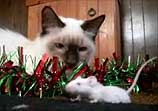
Cat Loves Mouse

Many times on this site, we've shown how mammals will adopt and coexist in harmony with odd species, even natural enemies.
http://us.i1.yimg.com/us.yimg.com/i/us/sch/cn/video06/4116816_rnd7975f788_18.jpg
Thursday, December 04, 2008
White Raccoon Sightings
Albino raccoon spotted in Riverside
November 03, 2008 at 08:40 PM
BY JANICE HOPPE
RIVERSIDE—With ghostly white fur and gripping claws, an elusive creature creeping through trees has piqued the interest of a Riverside neighborhood.
Melinda Lehman and Jim Cybul, Lionel Road residents, live on the block where rumors were circulating about a strange, ghostly animal. No one had any clear idea of what it was. They said neighbors had spotted this thing, but no one ever got a good look at it.
“About a month ago, we began hearing about a white creature,” Lehman said. “It became an urban legend—it was seen in the neighbor’s lawn and trees and someone saw it in their back yard.”
Someone said it was not a raccoon or a badger, but it looked familiar, like a fuzzy cat.
”(One neighbor) drew a conclusion that wild cats were mating with opossums and this was now the result,” Cybul said. “Of course, we all laughed hysterically at this.”
On Oct. 23, Cybul was barbecuing in his back yard when he saw something walk down the driveway. It was clearly a raccoon, but it was white.
“We have proof of what it is and researched it,” Cybul said. “Albino raccoons do appear physically different as opposed to the average raccoon.”
Scott Garrow, wildlife biologist for the Illinois Department of Natural Resources, said it is an unusual animal, but albino mammals do exist.
“It is genetic. The genes for albinism will show up; it is like a recessive gene that normally doesn’t occur,” he said.
Normally, albino animals are not seen in the wild because they don’t survive, according to Garrow.
“It is not something that will persist,” he said. ”(We) won’t see a cluster of raccoons, and it will probably die out.”
_____
Jan 31, 2007 Morgantown WV
Rare white raccoon captured downtown: Albino, sibling found near Pleasant Street released to woods.
Byline: J. Miles Layton
Jan. 31--An albino raccoon was captured foraging for food this week outside an apartment building on Pleasant Street in Morgantown. The critter is white, has pink eyes with a slightly yellow hue, weighs 7 or 8 pounds, and is about a foot long.
The black mask usually found around a raccoon's eyes was a deeper shade of white. Mike Gray, a professional trapper with 30 years of experience, caught the creature and one of its regularly colored siblings by using marshmallows as bait to bring them inside a cage trap.
_____
November 03, 2008 at 08:40 PM
BY JANICE HOPPE
RIVERSIDE—With ghostly white fur and gripping claws, an elusive creature creeping through trees has piqued the interest of a Riverside neighborhood.
Melinda Lehman and Jim Cybul, Lionel Road residents, live on the block where rumors were circulating about a strange, ghostly animal. No one had any clear idea of what it was. They said neighbors had spotted this thing, but no one ever got a good look at it.
“About a month ago, we began hearing about a white creature,” Lehman said. “It became an urban legend—it was seen in the neighbor’s lawn and trees and someone saw it in their back yard.”
Someone said it was not a raccoon or a badger, but it looked familiar, like a fuzzy cat.
”(One neighbor) drew a conclusion that wild cats were mating with opossums and this was now the result,” Cybul said. “Of course, we all laughed hysterically at this.”
On Oct. 23, Cybul was barbecuing in his back yard when he saw something walk down the driveway. It was clearly a raccoon, but it was white.
“We have proof of what it is and researched it,” Cybul said. “Albino raccoons do appear physically different as opposed to the average raccoon.”
Scott Garrow, wildlife biologist for the Illinois Department of Natural Resources, said it is an unusual animal, but albino mammals do exist.
“It is genetic. The genes for albinism will show up; it is like a recessive gene that normally doesn’t occur,” he said.
Normally, albino animals are not seen in the wild because they don’t survive, according to Garrow.
“It is not something that will persist,” he said. ”(We) won’t see a cluster of raccoons, and it will probably die out.”
_____
Jan 31, 2007 Morgantown WV
Rare white raccoon captured downtown: Albino, sibling found near Pleasant Street released to woods.
Byline: J. Miles Layton
Jan. 31--An albino raccoon was captured foraging for food this week outside an apartment building on Pleasant Street in Morgantown. The critter is white, has pink eyes with a slightly yellow hue, weighs 7 or 8 pounds, and is about a foot long.
The black mask usually found around a raccoon's eyes was a deeper shade of white. Mike Gray, a professional trapper with 30 years of experience, caught the creature and one of its regularly colored siblings by using marshmallows as bait to bring them inside a cage trap.
_____
Weird White Raccoon

This white raccoon lives in the woods near a Rockledge subdivision. Brevard Zoo officials say they cannot capture and display the rare animal because it is healthy.
_____
Woman fears for albino raccoon's safety
BY RICK NEALE • FLORIDA TODAY • December 1, 2008
The pale-furred mutant likes to munch on grapes and cat food, said a woman who feeds and photographs the elusive animal. Fearful for the albino creature's safety, the woman asked Brevard Zoo officials to trap it and put it on public display. She asked FLORIDA TODAY to withhold her identity so hunters would not converge on the raccoon's territory.
"I'd hate to see him get shot as a trophy," she said. "This is something kids would love to see. He is so unique."
Michelle Smurl, Brevard Zoo's director of animal programs, said the zoo is not at liberty to trap an adult animal that is thriving in the wild. She viewed photos of the animal and confirmed that it is a white raccoon.
"The raccoon looks healthy, and it looks like it's doing well," Smurl said. "I grew up with white squirrels up in New York, and I was worried that someone was going to shoot them."
Raccoons are common across the state and live "everywhere there are trees," according to the Florida Fish and Wildlife Conservation Commission's Web site. These omnivores are about the size of a small dog and are identifiable by "black mask" facial features and bushy ringed tails.
But according to a KFOR-TV report of an Oklahoma white raccoon sighting, only one in 750,000 albino raccoons will survive to adulthood.
Earlier this month, a ghostly white raccoon startled an Illinois man during a backyard barbecue, Prairie State Outdoors reported.
Two ivory-colored raccoons were trapped earlier this year in Tennessee, leading a Memphis Commercial Appeal outdoors columnist to proclaim, "You have a better chance of being struck by a bolt from Mother Nature than seeing an albino raccoon."
Smurl said humans should not feed raccoons because they are wild animals.
Tuesday, November 25, 2008
Cat Survives!

While this is not an everyday occurance, it does happen frequently. This is just a more extreme case. Cats tend to find warm, quiet places as it gets cool outside, and cars are a perfect (in their feline minds) place. Then, severe injuries or death can occur. Use care, and don't let your treasured inside cat outside.
_____
Cat's week under car bonnet (hood). November 2008
An Austrian motorist couldn't work out why his Mercedes car was "purring" along better than normal - until he looked under the bonnet.
Peter Hochberger discovered his neighbour's terrified moggie Luna had been perched on the engine block - for nearly a week.
Lucky Luna had survived more than 300 miles of motoring without food or water before her mewing raised the alarm.
The petrified puss had hidden so deep inside the engine that it had to be dismantled to get her out.
Mechanic Walter Doerfler, 48, said: "I have no idea how she got so far into the engine, it was a major job to take parts off so we could reach her."
Amazingly she escaped with just some minor singes to her fur and is now back with her family in Ruprechtshofen, Austria, counting her eight remaining lives.
Relieved owner Erwin Taurok said: "It is a miracle that Luna survived the odyssey without food or water almost unharmed. We were worried about her after she didn't turn up for a week and had put up posters with her picture - we are delighted to have her back."
Tuesday, November 11, 2008


Monday, September 22, 2008
The Sad Story of Feral Bees and Hurican Ike
On Saturday (20 September) my wife and I decided to go on a looooong walk inspecting the damage of beloved but wounded neighboring Park. Ike had stomped it pretty good. Ike had swept in with little advanced warning as to its severity, and we were very lucky. We lost power for 5 days, but so many others suffered more severely.
Anyway, about 2 miles into our walk, since we had to start from the bottom of the park - couldn't drive up - we surveyed the uprooted and mangled trees. The woodpeckers were in Heaven, with so many colonies of carpenter ants and other bugs exposed for the taking.
I digress a moment. Last Spring, we were walking the same area and came upon a hawk sitting in a tree. It was a bit spooked by our approach and flew off. That's when we heard a ferocious buzzing sound and across from the "hawk tree" we saw a mass (like smoke) of honey bees ferreting out a new home. Feral bees.
My friend, Casper, tells me that feral bees are very rare and so we were impressed, a bit nervous, but proud we could witness such a sight. Each time we walked by that area, we looked but saw very little sign of the bees. We suspected that they didn't take, and had moved on. Saturday, we realized we'd misled ourselves.
The "bee tree" was one of the mangled trees, though the "hawk tree" remained intact.
There were a few bees, so I said "Let's look a minute". As my eyes focused, I saw a bit of bee hive laying on the broken trunk, now laying prostrate on the ground. Then I spied the rest. Sadly, it was split into at least two slabs and that one fragment I first spied: Just laying on top of the felled tree. I suppose the bees had nearly a week to die out, but there were survivors still.
We mourned a moment and then walked on through the debris field. We'll always keep fond memories of the "bee tree" and that lone colony of feral honey bees.
Anyway, about 2 miles into our walk, since we had to start from the bottom of the park - couldn't drive up - we surveyed the uprooted and mangled trees. The woodpeckers were in Heaven, with so many colonies of carpenter ants and other bugs exposed for the taking.
I digress a moment. Last Spring, we were walking the same area and came upon a hawk sitting in a tree. It was a bit spooked by our approach and flew off. That's when we heard a ferocious buzzing sound and across from the "hawk tree" we saw a mass (like smoke) of honey bees ferreting out a new home. Feral bees.
My friend, Casper, tells me that feral bees are very rare and so we were impressed, a bit nervous, but proud we could witness such a sight. Each time we walked by that area, we looked but saw very little sign of the bees. We suspected that they didn't take, and had moved on. Saturday, we realized we'd misled ourselves.
The "bee tree" was one of the mangled trees, though the "hawk tree" remained intact.
There were a few bees, so I said "Let's look a minute". As my eyes focused, I saw a bit of bee hive laying on the broken trunk, now laying prostrate on the ground. Then I spied the rest. Sadly, it was split into at least two slabs and that one fragment I first spied: Just laying on top of the felled tree. I suppose the bees had nearly a week to die out, but there were survivors still.
We mourned a moment and then walked on through the debris field. We'll always keep fond memories of the "bee tree" and that lone colony of feral honey bees.
Saturday, August 23, 2008
Rare four-eared cat's story.

_____
Yoda, a smoke-colored feline whose four ears give him the appearance of a horned devil, became the toast of several high-profile Web sites the week of 17 August 2008. The blogosphere quickly pounced on the story of a 2-year-old cat who had been a barroom oddity before he was adopted by a suburban couple. Ted and Valerie Rock found Yoda in 2006 while watching a Bears game at a Blue Island bar with fellow volunteers from the Greater Chicago Food Depository. Patrons were passing the 8-week-old kitten around, mocking his appearance and calling him names such as "Devil Cat" and "Beelzebub." The Rocks took pity on the kitty and offered to adopt him. The establishment's owner, who kept the cat in a cage atop the bar to amuse patrons, agreed.
Thursday, July 31, 2008
Weird Cat Law

Cats in the Saudi capital Riyadh.
_____
Saudi Arabia's religious police have announced a ban on selling pet cats or exercising them in public in the Saudi capital, because of men use them as a means of making passes at women, an official has said.
Golden Retriever Nurses White Tigers

Golden retriever adopts tiger cubs at Kansas zoo
Thu Jul 31, 7:27 AM ET
CANEY, Kan. - A dog at a southeast Kansas zoo has adopted three tiger cubs abandoned by their mother. Safari Zoological Park owner Tom Harvey said the tiger cubs were born Sunday, but the mother had problems with them.
ADVERTISEMENT
A day later, the mother stopped caring for them. Harvey said the cubs were wandering around, trying to find their birth mother, who wouldn't pay attention to them. That's when the cubs were put in the care of a golden retriever, Harvey said.
Harvey said it's unusual for dogs to care for tiger cubs, but it does happen. He said he has seen reports of pigs nursing cubs in China, and he actually got the golden retriever after his wife saw television accounts of dogs caring for tiger cubs.
Puppies take about the same amount of time as tiger cubs to develop, and Harvey said the adoptive mother just recently weaned her own puppies.
"The timing couldn't have been any better," he said.
The mother doesn't know the difference, Harvey said. He said the adopted mother licks, cleans and feeds the cubs.
The Safari Zoological Park is a licensed facility open since 1989 and specializes in endangered species.
It has leopards, lions, cougars, baboons, ring-tailed lemurs, bears and other animals. It currently has seven white tigers and two orange tigers.
Because whit tigers are inbred from the first specimen found more than a half-century ago, they are not as genetically stable as orange tigers.
The zoo's previous litter of white tiger cubs was born April 23, although one of the three has since gone to a private zoo near Oklahoma City.
Monday, July 14, 2008
Black-crowned night-heron: Rescued!
Heart warming rescue as reported in the Louisville Courier-Journal


Firefighters rescue injured heron
Bird found in Cherokee Park
By Charlie White • cwhite@courier-journal.com • July 14, 2008
A crowd of several dozen people cheered firefighters yesterday after they rescued an injured heron from a sycamore tree in Cherokee Park.
Several people had called 911 during the morning to report that the bird, a black-crowned night-heron, had become tangled on a piece of line near a bridge on Scenic Loop over Beargrass Creek.
The heron had injured its right wing and lost a few feathers, but it was conscious when it was taken away by Eileen and John Wicker of Raptor Rehab of Kentucky.
Nate Paulson and Capt. Kent McCauley of Louisville Fire & Rescue climbed a ladder to reach the heron, then carried it down just before noon. The bird appeared to have been caught on a piece of kite string or fishing line, and it was unclear how long it had been there.
"At the very least, it has a dislocated shoulder," Eileen Wicker said.
The Wickers gave the bird fluid before putting it in a cage in the back of their van. It was the second one they had rescued the same day; another found off Eastern Parkway.
The Wickers were taking the herons to a woman who has worked at the Louisville Zoo and said she would nurse them back to health.
Black-crowned night-herons are common in the St. Joseph neighborhood and in other parts of the metro area. According to the Cornell Lab of Ornithology, they have a wingspan of about 45 inches and produce a loud, harsh squawk.
*****
John Wicker is with Raptor Rehab Kentucky. (By Charlie White, The Courier-Journal / July 13, 2008)
_____
Firefighters rescue injured heron
Bird found in Cherokee Park
By Charlie White • cwhite@courier-journal.com • July 14, 2008
A black-crowned night-heron was plucked from a sycamore tree in Cherokee Park just before noon today after the bird had become tangled on a piece of line. Firefighters climbed a ladder to reach the heron near a bridge on Scenic Loop, over Beargrass Creek. Several onlookers had called 911 earlier. The bird appeared to be caught on a piece of kite string or fishing line, and it was unclear how long it had been there. Officials from a raptor rehabilitation center also responded, and said the bird was alert and conscious after the rescue, but that its right wing was damaged.According to the Cornell Lab of Ornithology, black-crowned night-herons have a wingspan of about 45 inches, and produce a loud, harsh squawk. They eat snakes, rodents, fish and lizards.


A black-crowned night-heron appeared to have been caught on a piece of kite string or fishing line in a sycamore tree near a bridge in Cherokee Park. The bird had injured its right wing and lost a few feathers.
_____Firefighters rescue injured heron
Bird found in Cherokee Park
By Charlie White • cwhite@courier-journal.com • July 14, 2008
A crowd of several dozen people cheered firefighters yesterday after they rescued an injured heron from a sycamore tree in Cherokee Park.
Several people had called 911 during the morning to report that the bird, a black-crowned night-heron, had become tangled on a piece of line near a bridge on Scenic Loop over Beargrass Creek.
The heron had injured its right wing and lost a few feathers, but it was conscious when it was taken away by Eileen and John Wicker of Raptor Rehab of Kentucky.
Nate Paulson and Capt. Kent McCauley of Louisville Fire & Rescue climbed a ladder to reach the heron, then carried it down just before noon. The bird appeared to have been caught on a piece of kite string or fishing line, and it was unclear how long it had been there.
"At the very least, it has a dislocated shoulder," Eileen Wicker said.
The Wickers gave the bird fluid before putting it in a cage in the back of their van. It was the second one they had rescued the same day; another found off Eastern Parkway.
The Wickers were taking the herons to a woman who has worked at the Louisville Zoo and said she would nurse them back to health.
Black-crowned night-herons are common in the St. Joseph neighborhood and in other parts of the metro area. According to the Cornell Lab of Ornithology, they have a wingspan of about 45 inches and produce a loud, harsh squawk.
*****
*****
John Wicker is with Raptor Rehab Kentucky. (By Charlie White, The Courier-Journal / July 13, 2008)
_____
Firefighters rescue injured heron
Bird found in Cherokee Park
By Charlie White • cwhite@courier-journal.com • July 14, 2008
A black-crowned night-heron was plucked from a sycamore tree in Cherokee Park just before noon today after the bird had become tangled on a piece of line. Firefighters climbed a ladder to reach the heron near a bridge on Scenic Loop, over Beargrass Creek. Several onlookers had called 911 earlier. The bird appeared to be caught on a piece of kite string or fishing line, and it was unclear how long it had been there. Officials from a raptor rehabilitation center also responded, and said the bird was alert and conscious after the rescue, but that its right wing was damaged.According to the Cornell Lab of Ornithology, black-crowned night-herons have a wingspan of about 45 inches, and produce a loud, harsh squawk. They eat snakes, rodents, fish and lizards.
Monday, July 07, 2008
Finnegan the Squirrel
Finnegan the squirrel
Debby C-, who plans to release Finnegan, the young squirrel, back into the wild, bottle-fed the infant squirrel after it was brought to her house.
When C- took in the tiny creature and began caring for him, she found herself with an unlikely nurse's aide: her pregnant Papillion, Mademoiselle Giselle.

Finnegan was resting in a nest in a cage just days before Giselle was due to deliver her puppies.

C- and her husband watched as the dog dragged the squirrel's cage twice to her own bedside before she gave birth.

Cantlon was concerned, yet ultimately decided to allow the squirrel out and the inter-species bonding began.
Finnegan rides a puppy mosh pit of sorts, burrowing in for warmth after feeding, eventually working his way beneath his new litter mates.

Now, Finnegan mostly uses a bottle, but still snuggles with his 'siblings' in a mosh pit of puppies, rolling atop their bodies, and sinking in deeply for a nap.
 Two days after giving birth, mama dog Giselle allowed Finnegan to nurse; family photos and a videotape show her encouraging him to suckle alongside her litter of five pups.
 Finnegan and his new litter mates, five Papillion puppies, get along together as if they were meant to.
 Finnegan naps after feeding.

Finnegan makes himself at home with his new litter mates, nuzzling nose-to-nose for a nap after feeding.

This came in an email to brighten up the day! Wouldn't it be nice if we could all get along like Finnegan and the gang? MORAL OF THE STORY: Keep loving everyone, even the squirrelly ones!
Debby C-, who plans to release Finnegan, the young squirrel, back into the wild, bottle-fed the infant squirrel after it was brought to her house.
When C- took in the tiny creature and began caring for him, she found herself with an unlikely nurse's aide: her pregnant Papillion, Mademoiselle Giselle.

Finnegan was resting in a nest in a cage just days before Giselle was due to deliver her puppies.

C- and her husband watched as the dog dragged the squirrel's cage twice to her own bedside before she gave birth.

Cantlon was concerned, yet ultimately decided to allow the squirrel out and the inter-species bonding began.
Finnegan rides a puppy mosh pit of sorts, burrowing in for warmth after feeding, eventually working his way beneath his new litter mates.

Now, Finnegan mostly uses a bottle, but still snuggles with his 'siblings' in a mosh pit of puppies, rolling atop their bodies, and sinking in deeply for a nap.
 Two days after giving birth, mama dog Giselle allowed Finnegan to nurse; family photos and a videotape show her encouraging him to suckle alongside her litter of five pups.
 Finnegan and his new litter mates, five Papillion puppies, get along together as if they were meant to.
 Finnegan naps after feeding.
Finnegan makes himself at home with his new litter mates, nuzzling nose-to-nose for a nap after feeding.

This came in an email to brighten up the day! Wouldn't it be nice if we could all get along like Finnegan and the gang? MORAL OF THE STORY: Keep loving everyone, even the squirrelly ones!
Subscribe to:
Posts (Atom)